Honors Program Takes Learning Beyond the Classroom with First Study Abroad Trip to Iceland
Earlier this spring, nine students in Monroe’s Honors Program embarked on the trip of a lifetime, heading to Iceland for a weeklong academic and cultural enrichment experience that began in the capital city of Reykjavik.
Accompanied by Dr. Karenann Carty, Senior Vice President for Academic and Student Affairs, and Professor Kat MacDonald, Director of the Honors Program, the students spent their time in the “Land of Fire and Ice” engaged in interdisciplinary learning, service, cultural exploration and reflection -- all in keeping with the program’s mission.
The group reflected the rich diversity of the Honors Program, bringing together students from New York and around the world, including members of the Career Pathways program and a fully online student who had not previously had the opportunity to connect with many of her Honors Program peers in person.
“It was a trip with a lot of ‘firsts,’” said Professor MacDonald.
For Maria Antonetty, a fully online Criminal Justice student from the Bronx, those firsts included boarding an airplane and traveling outside the United States for the first time.
“It was my first time flying. It was my first time being out of the country,” Antonetty said. “From beginning to end, it was such an amazing experience. It’s something I will never forget.”
The vision to bring Honors students abroad had been a long time in the making. Knowing that a semester-long program would be difficult for many students to commit to, Professor MacDonald sought out shorter study-abroad opportunities that would still allow for meaningful learning experiences.
After ongoing discussions with Senior Vice President of International Programs Evan Jerome, Professor MacDonald landed on Compass Path, a program that offered a weeklong experience and incorporated a volunteer component aligned with the Honors Program’s service-learning approach. Its affordable cost, manageable length, meaningful service-learning component and distinctive cultural experiences combined to create a once-in-a-lifetime opportunity for students.
“It was really a great experience for the students to go on, but it was also financially feasible for our students who did end up participating,” Professor MacDonald said.
The nine participating students included Antonetty, Cassie Brache, Gizzel Calliste, Mckeown Essuon, Janehsa Hyliger, Karen Rodriguez, Kayanndra Scarlett, Deshorn Spence and Angelique Stapleton.
To help make the experience more accessible, the Honors Program provided each participating student with a $1,000 travel grant, with additional financial assistance available to students based on demonstrated need. The Honors Program aims to bring unique learning experiences to students, particularly high-achieving students from diverse backgrounds that may not have otherwise have access to those activities.
“Some of the most meaningful learning happens when students step outside of the classroom and into unfamiliar environments,” said Senior Vice President Carty. “Experiences like this challenge students to think critically, engage with different cultures, and see themselves as global citizens. They return not only with new knowledge, but with greater confidence, perspective, and a deeper understanding of how they can contribute to the world around them.”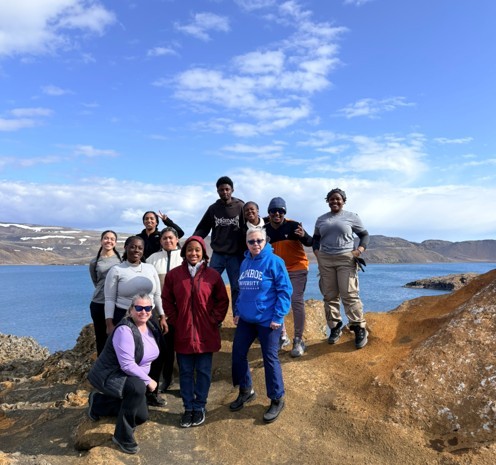
Professor MacDonald saw the trip as the perfect opportunity to connect students’ experiences to Comparative Urbanism, a course in which they learn about how cities are structured and operate. For students accustomed to New York City and the greater metropolitan area, traveling to Reykjavik offered an experiential applied-learning opportunity, as the quiet city provided a stark contrast to the hustle and bustle of the Big Apple.
Students later visited and volunteered at a forestry site, where they learned about Iceland’s landscape and its efforts to maintain human-planted forests that require ongoing care in the country’s harsh environment. They moved branches to line walking paths, helping guide foot traffic away from delicate plant life, and worked in the nursery. The experience demonstrated the sensitive nature of ecosystems and their connections to climate and human activity.
“We all learned a lot about geography and climate,” Professor MacDonald said. “It was really eye-opening.”
Following their service days, the group ventured beyond Reykjavik to visit the bridge between two continents, black-sand beaches and lava fields, and to go horseback riding. Because the students visited in late spring, Iceland was experiencing a period of almost continuous daylight, with the sun rising around 4:00 am and not setting until approximately 11:00 pm.
Antonetty said the trip helps bring together learning and cultural exploration – something that felt like a true “Honors Program” experience.
“No matter what -- even if we were having fun -- we were still learning and that’s what I enjoyed,” she said. “That’s what I will always remember.”
Now back stateside, the students continue to reflect on the trip and are developing a culminating project that they will present at the annual Honors Conference on July 17 in the Mintz Auditorium on the Bronx campus.
“I think being able to take some time to look back and unpack everything that we experienced will reap even greater returns for these students,” Professor MacDonald said. “I think they’ll find that they learned even more than they realized – that learning happens in all kinds of environments, in all kinds of ways.”